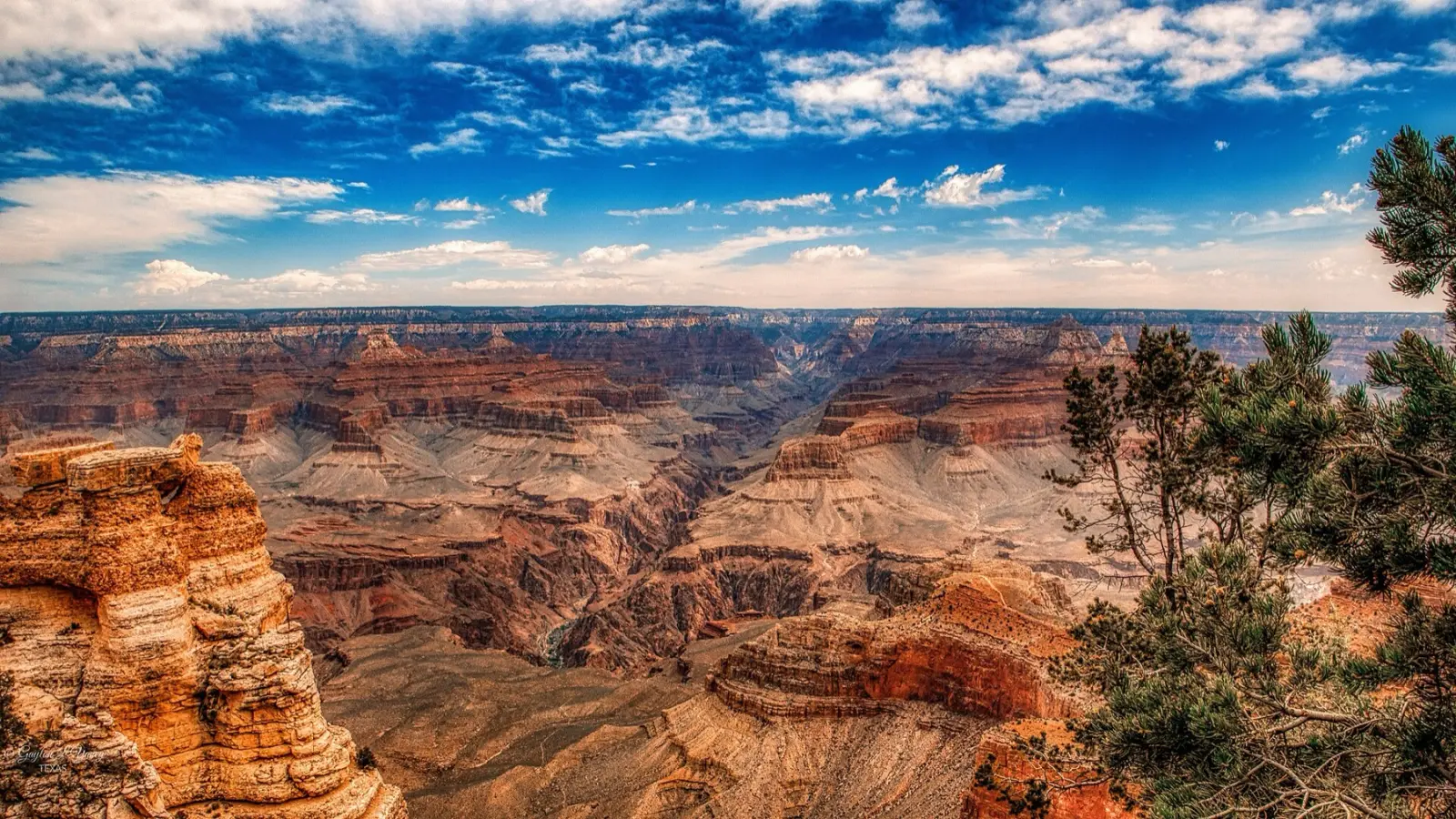
Route 66 doesn't go to the Grand Canyon. The closest it gets is Williams, Arizona, where the South Rim is about 60 miles north on Arizona Highway 64, roughly an hour's drive by the National Park Service's own estimate. From Flagstaff it's about 80 miles and an hour and a half. Most travelers make it a one-day detour: drive up in the morning, or ride the Grand Canyon Railway from the Williams depot, and sleep in Williams twice. Entrance costs $35 per private vehicle, good for seven days.
I'm Helena. I drove the whole of Route 66 in April 2026 for my Field Manual, and the Grand Canyon is the one side trip I'd never tell a first-timer to skip. Below are the real distances, the two ways to get there, the 2026 fees, how many days to add, and the other national park sites you pass on the old road, including the only national park that Route 66 actually runs through. If you're still sketching the whole state, my guide to the Route 66 stops in Arizona covers it east to west.
How far is Route 66 from the Grand Canyon?
It depends on which Route 66 town you leave from and which part of the canyon you mean. Almost everyone on a Route 66 trip means the South Rim, the side that's open all year, with Grand Canyon Village, the lodges and the train depot.
- From Williams: about 60 miles north. Leave I-40 at exit 165 and take AZ-64 straight up across the Coconino Plateau. The Park Service puts it at about 60 minutes to the South Entrance.
- From Flagstaff: about 80 miles on US 180, which joins AZ-64 at Valle. The Park Service says about 90 minutes. US 180 is the prettier road, through the pines below the San Francisco Peaks, but it's two-lane and slower.
- Through the East Entrance: from Flagstaff you can also take US 89 north to Cameron and AZ-64 west into the park at Desert View. It's longer, but you see the canyon from the Desert View Watchtower first and then drive the rim road west to the village. A good way to make a loop: in one way, out the other.
The North Rim is a different trip altogether. By road it's 212 miles and about four and a half hours from the South Rim, according to the Park Service, and it's open only part of the year. It's not a Route 66 detour.
The canyon has a third, separate side: Grand Canyon West, with the glass Skywalk, is run by the Hualapai Tribe on its own land, not by the National Park Service, so it has its own tickets and its own rules. Peach Springs, on Route 66 west of Seligman, is the tribe's capital.
Williams to the Grand Canyon: drive or take the train?
Williams was the last Route 66 town to be bypassed by I-40, on October 13, 1984, 42 years ago today. Its downtown still runs along the old road, and it's the natural base for the canyon: motels, diners, the train depot, and an RV park with 124 paved full-hookup sites two blocks from Route 66. You have two ways up.
Driving yourself
Driving gives you the most time at the rim and the freedom to stay for sunset. Inside the park, free shuttle buses link the viewpoints along the rim, so you can park once at the visitor center near Mather Point and ride from there. The catch is parking: the park says its worst traffic and parking problems come during spring break and the summer months. In those seasons, get to the South Entrance early in the morning.
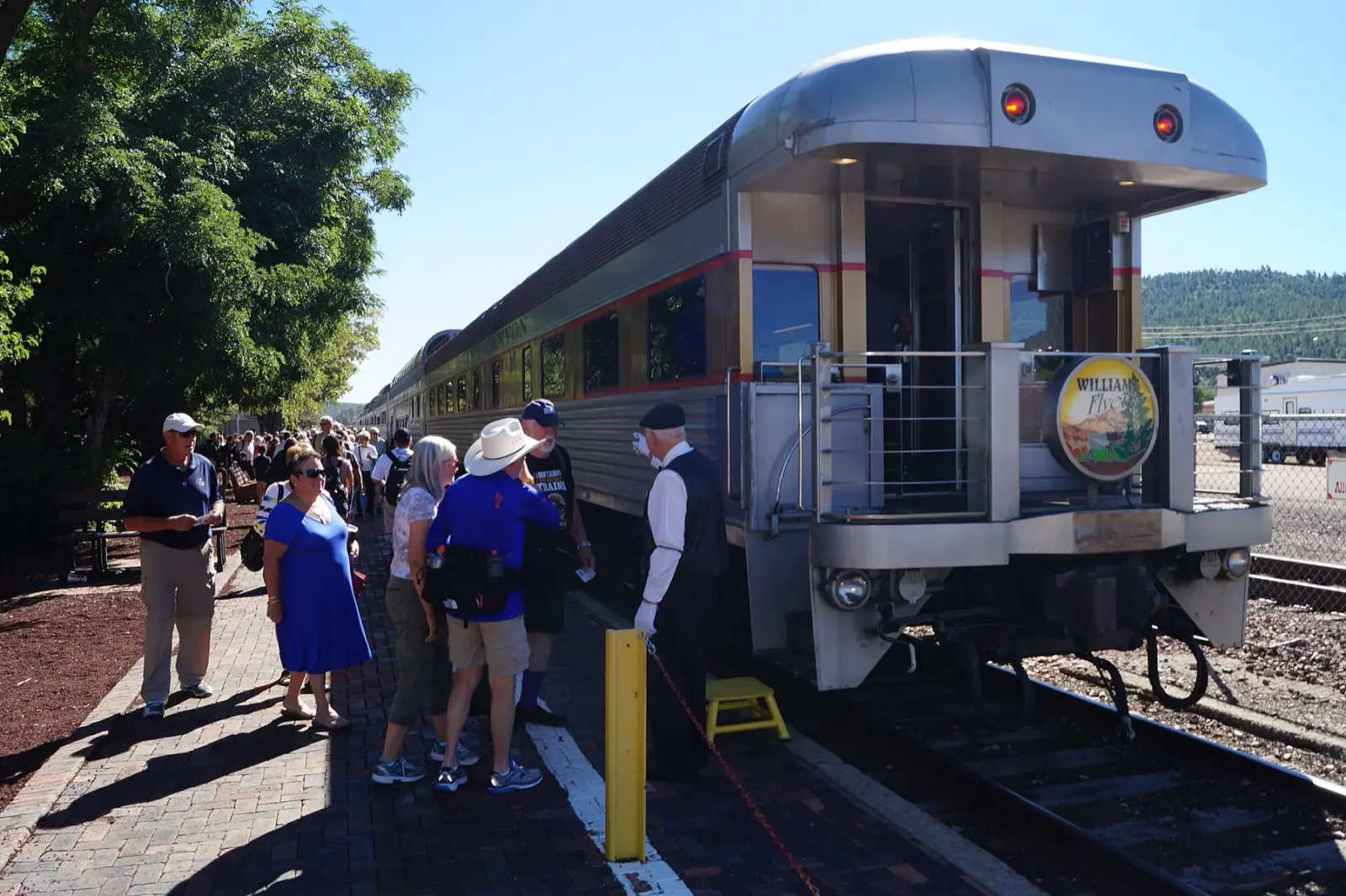
The Grand Canyon Railway
The train leaves the Williams depot daily at 9:30 a.m. and gets back at 5:45 p.m. In November and December it runs an hour earlier, leaving at 8:30 a.m. and returning at 4:45 p.m. You get a little over three hours at the South Rim, and the ride takes a bit more than two hours each way. It arrives at the old log depot right in Grand Canyon Village, a short walk from the rim.
When I checked the railway's site in October 2026, the lowest class, the Pullman car (a 1923 coach), was $69.98 round trip for adults 16 and up and $37.98 for children 2 to 15. The upper classes cost more. The national park entrance fee is a separate charge, so ask how it's handled when you book.
Which one I'd pick
If you've never seen the canyon and you're tired of driving by the time you reach Arizona, take the train. Someone else handles the road and the parking, and the three hours go to the rim walk between Mather Point and the village. If you want sunrise, sunset, Desert View, or more than one stretch of rim, drive. With children or anyone who loves trains, the railway turns the detour into its own event.
Grand Canyon entrance fees in 2026
These are the National Park Service's posted fees, which I checked on the park's fees page in October 2026. Each standard entrance pass is good for seven days, so a two-day visit costs the same as one.
| Pass | Price | Covers |
|---|---|---|
| Private vehicle | $35 | Everyone in one non-commercial car, 7 days |
| Motorcycle | $30 | One motorcycle and its riders, 7 days |
| Per person | $20 | Walking or cycling in, 7 days |
| Grand Canyon annual pass | $70 | This park only, 12 months |
| America the Beautiful annual pass (US residents) | $80 | Entrance at all national parks and federal recreation sites, 12 months |
| America the Beautiful annual pass (nonresidents) | $250 | The same, for visitors who are not US residents |
| Senior Pass (62 and over) | $20 a year or $80 for life | All federal recreation sites |
| Military, Access and 4th Grade passes | Free | Eligible visitors |
One change for 2026 matters if you're traveling with friends from abroad: the park's fee page now lists a $100 per person fee for nonresident visitors. If anyone in your car isn't a US resident, read that page before you go.
The math for a Route 66 trip is simple. Petrified Forest charges $25 per vehicle and the Grand Canyon $35, so the two together come to $60. An $80 America the Beautiful pass pays for itself once you add one more fee-charging site, and if you're 62 or older, the $20 Senior Pass is the best deal on the road. I break down the rest of the budget in what a Route 66 road trip costs.
How many days should you add for the Grand Canyon?
One full day is the honest minimum. Sleep in Williams the night before, spend the day at the South Rim, and sleep in Williams again. That's how I build it into my one-week western Route 66 plan, where the canyon is day 4, about 120 miles round trip.
Two days is better if you can spare them. You get a sunset and a sunrise, a slower walk along the rim, and the drive out through Desert View. For that, book a room inside the park or in Tusayan, just outside the South Entrance, well ahead, because rooms near the rim go first in spring and summer.
| Plan | Extra days | Where to sleep | What you get |
|---|---|---|---|
| Train day trip | 1 | Williams, two nights | About 3 hours at the rim, no driving |
| Driving day trip | 1 | Williams, two nights | Rim walk and shuttles, back by dark or after sunset |
| Rim overnight | 2 | Williams, then the park or Tusayan | Sunset, sunrise, Desert View on the way out |
| Loop from Flagstaff | 1-2 | Flagstaff, then the park or Williams | In by US 180, out by Desert View and Cameron (or the reverse) |
If you're working out how this fits into the whole trip, the free Route 66 trip planner gives miles, hours and days between 56 towns, and my piece on how long Route 66 takes shows where an extra day costs you least.
When to go to the Grand Canyon on a Route 66 trip
The park says it is least crowded from November through February and busiest during spring break and summer. Fall is the sweet spot for most Route 66 drivers, with cooler days and fewer people than summer. In winter, remember that the South Rim sits at about 7,000 feet, like Flagstaff, so snow can close or slow AZ-64 and US 180. Check the road before you leave Williams. I cover the season-by-season picture in the best time to drive Route 66.
Route 66 national parks: the other park sites on the road
The Grand Canyon is a detour. Petrified Forest is the opposite: Route 66 runs right through it.
Petrified Forest National Park, Arizona
Petrified Forest is the only national park in the country that contains a segment of Route 66. The old alignment crossed the park, and today a pullout marks the spot, with a rusted 1932 Studebaker sitting where the road ran. The park road is 28 miles long, between the north entrance at I-40 exit 311 and the south entrance near Holbrook, so you can drive through without backtracking and lose very little time. Entrance is $25 per vehicle, good for seven days. On the north end, the Painted Desert Inn, a historic lodge on the rim of the Painted Desert, is now a museum.
Two practical notes. There's no campground in the park, so sleep in Holbrook. And the park closes in the evening, so come through in daylight: it's the best first stop in Arizona if you're driving west.
Other National Park Service sites near Route 66
Plenty of Park Service units sit along or just off the old road. None of them is on Route 66 the way Petrified Forest is, but several are close enough for a stop of an hour or two:
- Lincoln Home National Historic Site, Springfield, Illinois: Abraham Lincoln's house, in the city where Route 66 ran through downtown.
- Gateway Arch National Park, St. Louis, Missouri: the Arch, on the riverfront of the city where Route 66 crossed the Mississippi.
- Pecos National Historical Park, New Mexico: pueblo and mission ruins near the pre-1937 alignment, if you take the Santa Fe loop.
- Petroglyph National Monument, Albuquerque: thousands of rock carvings on the city's west side.
- El Malpais National Monument, near Grants, New Mexico: lava flows and sandstone bluffs south of I-40.
- Walnut Canyon National Monument, east of Flagstaff: cliff dwellings in a small canyon, off I-40 at exit 204.
- Sunset Crater Volcano and Wupatki National Monuments, north of Flagstaff: a cinder cone and pueblo ruins, linked by one loop road off US 89. They pair well with the East Entrance route to the canyon.
- Mojave National Preserve, California: the desert north of the old road between Needles and Barstow.
The Park Service also had a hand in the road itself. Congress set up the Route 66 Corridor Preservation Program in 1999, and through it the NPS has given cost-share grants to restore motels, gas stations and signs along all eight states. Meteor Crater, east of Flagstaff, is often mistaken for a park site, but it's privately owned and ticketed.
Grand Canyon Caverns: the other "Grand Canyon" on Route 66
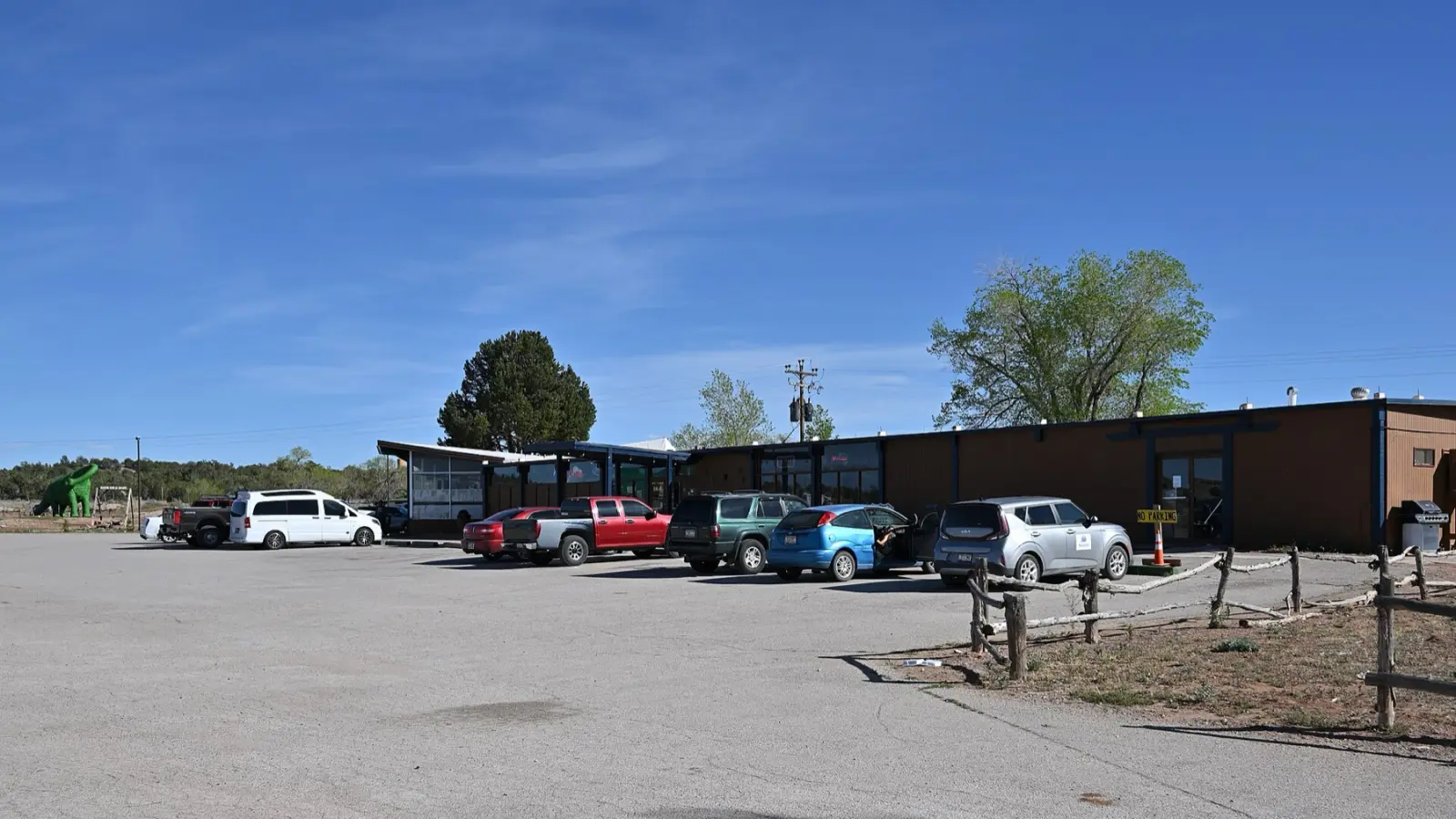
West of Seligman, on the longest unbroken stretch of Route 66, you'll pass signs for the Grand Canyon Caverns, with a big green dinosaur out front. It isn't part of the Grand Canyon and it isn't a park site; it's a private roadside attraction, and it's right on Route 66, so it costs you no detour at all.
An elevator takes you about 200 feet underground into one of the largest dry caverns in the United States. During the Cold War, in 1961, it was designated a fallout shelter. On its own site, the caverns list guided tours every hour on the half hour from 9:30 a.m., and when I checked in October 2026 the standard tour was $25.95 for adults 12 and up, $19.95 for seniors 55 and over, and $15 for children 4 to 11. There's also a motel and a restaurant on the property. Check the times before you go, because they can change.
Route 66 detours at a glance
Here's the whole set in one place, east to west. Prices are what I found on the official sites in October 2026.
| Detour | Leave Route 66 at | Distance and time | Plan for | Cost |
|---|---|---|---|---|
| Petrified Forest National Park | I-40 exit 311, out near Holbrook | 28-mile park road, no backtracking | 2-4 hours | $25 per vehicle |
| Walnut Canyon National Monument | I-40 exit 204, east of Flagstaff | A few miles off the interstate | 1-2 hours | NPS entrance fee |
| Grand Canyon South Rim by car | Flagstaff, US 180 | About 80 miles, 1.5 hours each way | A full day | $35 per vehicle |
| Grand Canyon South Rim by car | Williams, I-40 exit 165, AZ-64 | About 60 miles, 1 hour each way | A full day | $35 per vehicle |
| Grand Canyon Railway | Williams depot | 9:30 a.m. to 5:45 p.m. | A full day | From $69.98 per adult, park entrance extra |
| Grand Canyon Caverns | On Route 66, between Seligman and Peach Springs | No detour | 1-2 hours | From $25.95 per adult |
Is the Grand Canyon worth the detour from Route 66?
Yes, if you've never seen it. A day is enough to stand at the rim, walk a few miles of it, and understand why people drive across the country for it. If you've been before and your days are tight, spend them on the old road instead: the 158 miles from Crookton Road to Topock are the longest stretch of Route 66 left, and they deserve a slow day of their own. Either way, plan the canyon as its own day from Williams, not as a quick stop between towns.