Route 66 runs about 28 miles through Tulsa, from the Blue Whale in Catoosa on the east side to the edge of Sapulpa on the west. In driving order, the stops are the Blue Whale, the Route 66 Rising sculpture on Admiral Place, East 11th Street with the Meadow Gold sign and Buck Atom's Cosmic Curios, the Cyrus Avery Centennial Plaza and its East Meets West sculpture at the 11th Street Bridge, Southwest Boulevard through Red Fork with the Route 66 Historical Village, and then Sapulpa's 66-foot gas pump. You can see the highlights in half a day, but Tulsa is worth a night, because the neon is the point and it only works after dark.
I'm Helena. I drove the whole road, Chicago to Santa Monica, in April 2026 for my Route 66 Field Manual, and Tulsa is where Oklahoma's long two-lane stretch turns into a city street lined with signs. This guide is the close-up version of the Tulsa section in my Oklahoma stops guide, and it agrees with it on every fact. If you are planning around the 100th birthday on November 11, 2026, Tulsa is hosting the big party, and I cover that below too.
How many miles of Route 66 are in Tulsa?
Tulsa's tourism office counts 28 miles of Route 66 in the city. That figure covers the main drive through town on East 11th Street and Southwest Boulevard. Add the short run out to the Blue Whale in Catoosa and the drive down to Sapulpa, and the Tulsa stretch makes a natural day on its own.
There is more than one line on the map, which is why people get confused. The original 1926 alignment came into Tulsa from the northeast along Admiral Place, and that is why the Route 66 Rising sculpture and the site of Cyrus Avery's old tourist court and service station are up at Admiral and Mingo. The later and better-known alignment runs along East 11th Street, which is the one the city has lined with signs and neon. Both are drivable today. If you only have time for one, take 11th Street.
Route 66 Tulsa map: the stops in driving order
Here is the stretch east to west, the way you will meet it coming from Missouri and Kansas. Addresses are the ones the attractions publish; where a stop is a corner rather than a building, I give the area.
| Stop | Address or area | What you get |
|---|---|---|
| Blue Whale of Catoosa | 2600 N. Hwy 66, Catoosa | The 1972 whale and its new visitor center, free |
| Route 66 Rising | Admiral Place and Mingo Road traffic circle | A Route 66 shield sculpture 70 feet long |
| 11th Street alignment | East 11th Street, from 193rd East Ave. west | The main Route 66 drive through the city |
| Desert Hills Motel | 5220 E. 11th St. | A vintage motor inn with its cactus sign |
| Hawks Dairies building | 2415 E. 11th St. | Art Deco dairy, newly on the National Register |
| Mother Road Market | 11th Street and Lewis Avenue | Food hall, easy lunch stop |
| Buck Atom's Cosmic Curios | 1347 E. 11th St. | Space cowboy giant and a gift shop in an old gas station |
| Meadow Gold sign | 11th Street and Quincy Avenue | Restored neon, lit at night |
| Cyrus Avery Centennial Plaza | East end of the 11th Street Bridge, Southwest Blvd. and Riverside Drive | East Meets West sculpture and the 1916 bridge |
| Red Fork | Southwest Boulevard, west bank | Where Tulsa's oil boom started in 1901 |
| Route 66 Historical Village | 3770 Southwest Blvd. | Frisco 4500 steam engine and a 194-foot derrick, free |
| Heart of Route 66 Auto Museum | Sapulpa | Cars and the 66-foot gas pump |
| Rock Creek Bridge (Bridge 18) Plaza | 13000 W. Ozark Trail, Sapulpa | New park beside an old truss bridge |
For the whole road town by town, see my Route 66 map with cities.
East of town: the Blue Whale of Catoosa
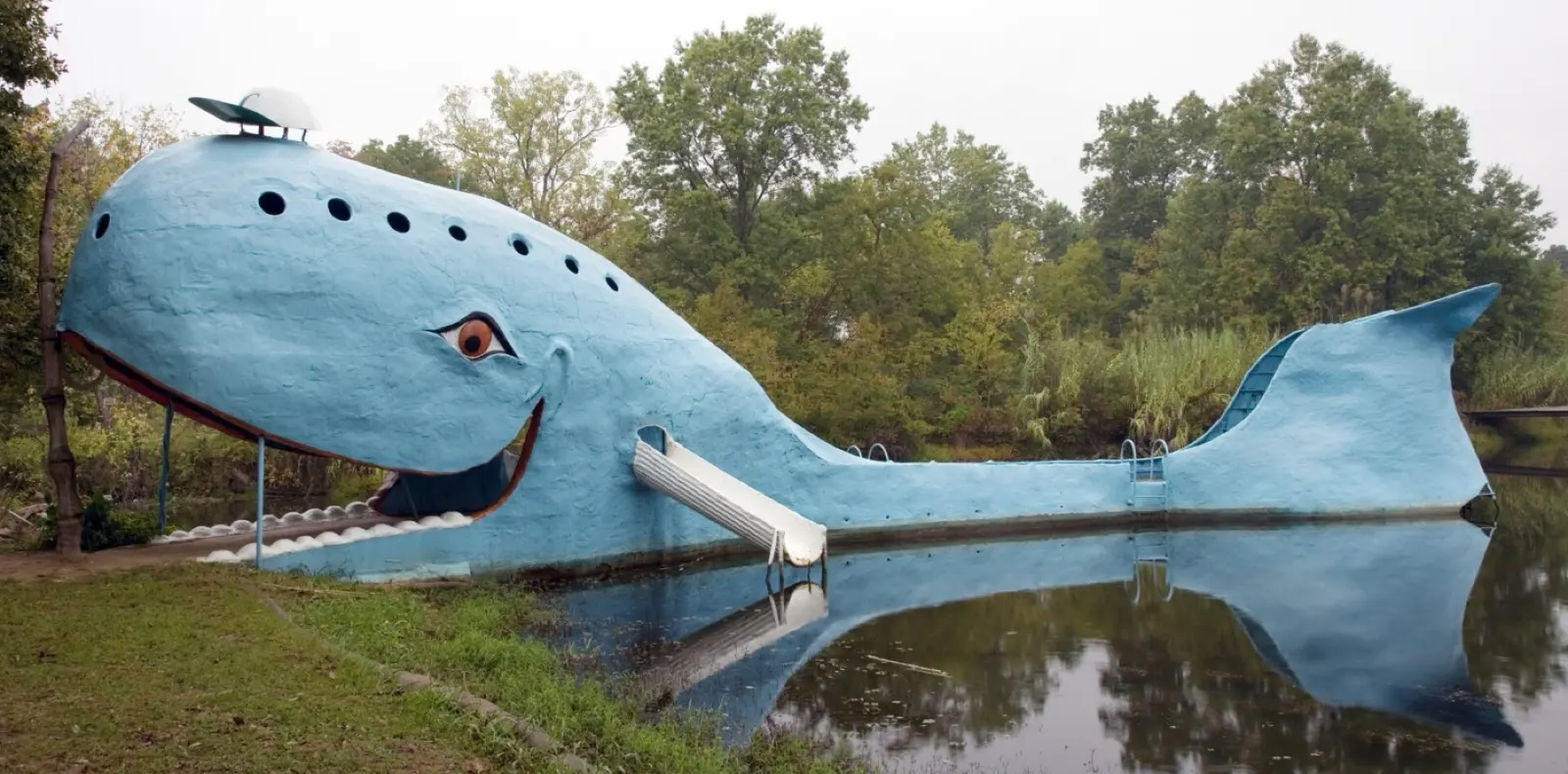
Most people start their Tulsa day at the whale. Hugh Davis built it in 1972 as an anniversary present for his wife, Zelta: 80 feet long, 20 feet tall, made from 126 sacks of concrete. It sits on a pond at 2600 N. Hwy 66 in Catoosa, on the northeast edge of the Tulsa area.
The whale had a big year. A 4,000-square-foot visitor center opened beside it on May 30, 2026, with a larger gift shop, historic photos, a concession area and new restrooms, which matters more than it sounds on a long driving day. Swimming in the pond is no longer allowed, but the visit is free. Go early in the morning if you want a photo without a crowd on the jaw.
From Catoosa into Tulsa
The local Route 66 group gives the simplest directions for getting from the whale onto the old road: take 193rd East Avenue, by the Hard Rock casino, south to 11th Street, about a mile from the interstate, and turn right. From there 11th Street carries you all the way into midtown.
The Admiral Place alignment and Route 66 Rising
If you want the older line, head for Admiral Place instead. The landmark there is Route 66 Rising, a giant Route 66 shield with "Tulsa" across the top, more than 30 feet high and 70 feet long, in the middle of the traffic circle at East Admiral Place and Mingo Road. It was dedicated on July 2, 2019, and the artist, Eric F. Garcia, is from New Mexico, another Route 66 state.
The spot was not chosen at random. Cyrus Avery, the Tulsan who pushed for a Chicago to Los Angeles highway through Oklahoma and is called the Father of Route 66, had his tourist court and service station at this corner. There is little left of it now, so treat this as a photo stop: the sculpture is the reason to come, and the traffic circle means you should park nearby and walk rather than stop on the road.
East 11th Street: Tulsa's main Route 66 drive
East 11th Street is the Route 66 most visitors mean when they say Tulsa. It is a working city street, with traffic lights and strip malls between the good parts, so do not expect a museum mile. What makes it special is how many old motels, gas stations and signs are still standing, and how many new ones have gone up.
Desert Hills Motel
Driving west from the east side, the first sign you will want a photo of is the Desert Hills Motel at 5220 E. 11th St., with its tall cactus sign. Visit Tulsa lists it as a vintage low-rise motor inn with kitchenettes and daily or weekly rates. It is a working budget motel, not a restored boutique property, so read recent reviews before you book.
Hawks Dairies and Mother Road Market
Closer in, at 2415 E. 11th St., the 1948 Art Deco Hawks Dairies building joined the National Register of Historic Places effective October 5, 2026, as I reported in this week's Route 66 news. A hotel plan for it fell through, so for now it is a building to look at. Directly across the street is Mother Road Market, a food hall at 11th and Lewis, which is the easiest lunch on the whole Tulsa stretch: many small kitchens under one roof, so everyone in the car can eat what they want.
Buck Atom's Cosmic Curios and the Meadow Gold sign
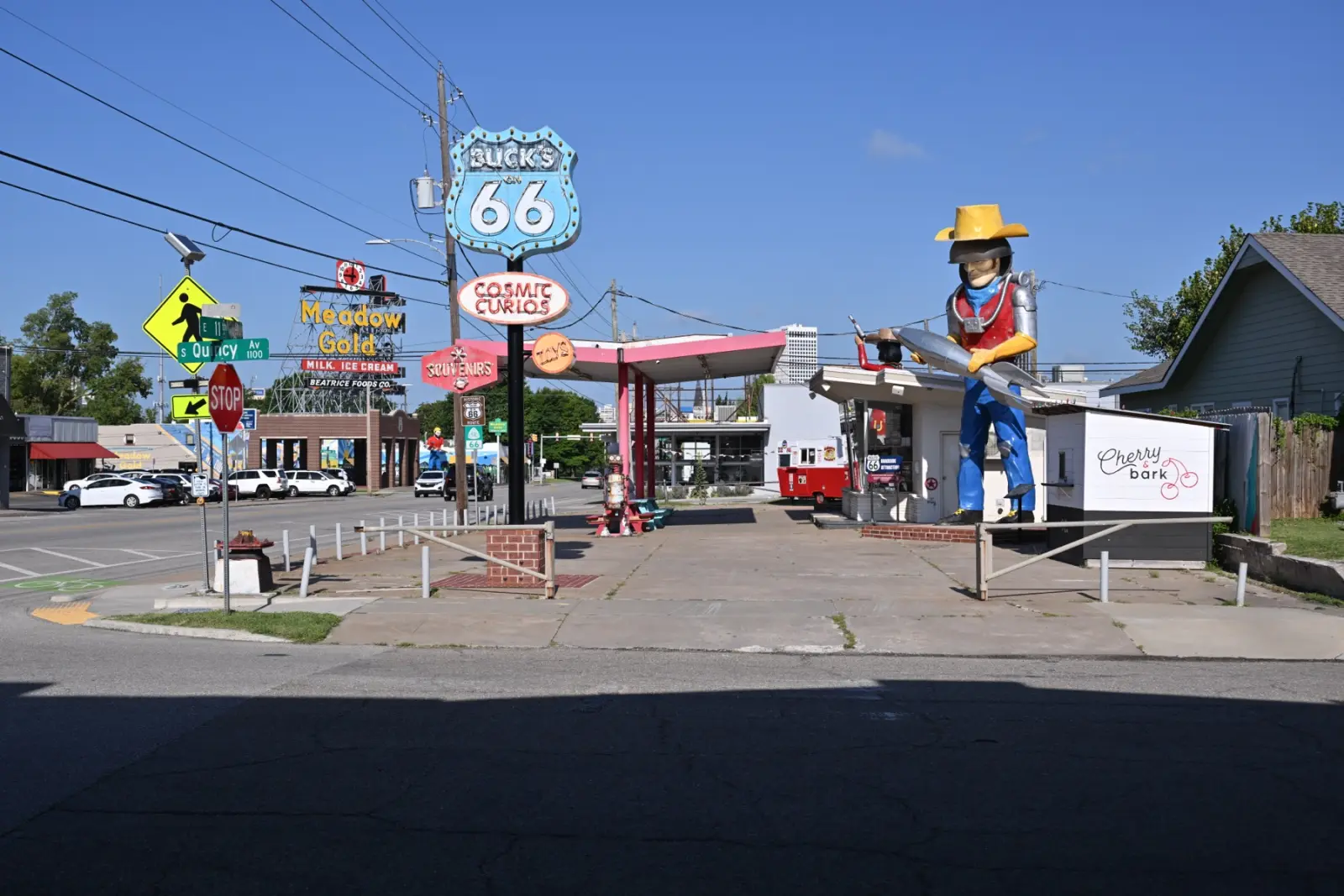
Two blocks that belong on every list sit at 11th Street and Quincy Avenue. Buck Atom's Cosmic Curios, at 1347 E. 11th St., is a souvenir shop in an old gas station, guarded by Buck himself, a 21-foot space cowboy holding a rocket. It is the photo you see at the top of this page. The shop sells Route 66 gifts and local work, and the giant is free to photograph whether or not the shop is open.
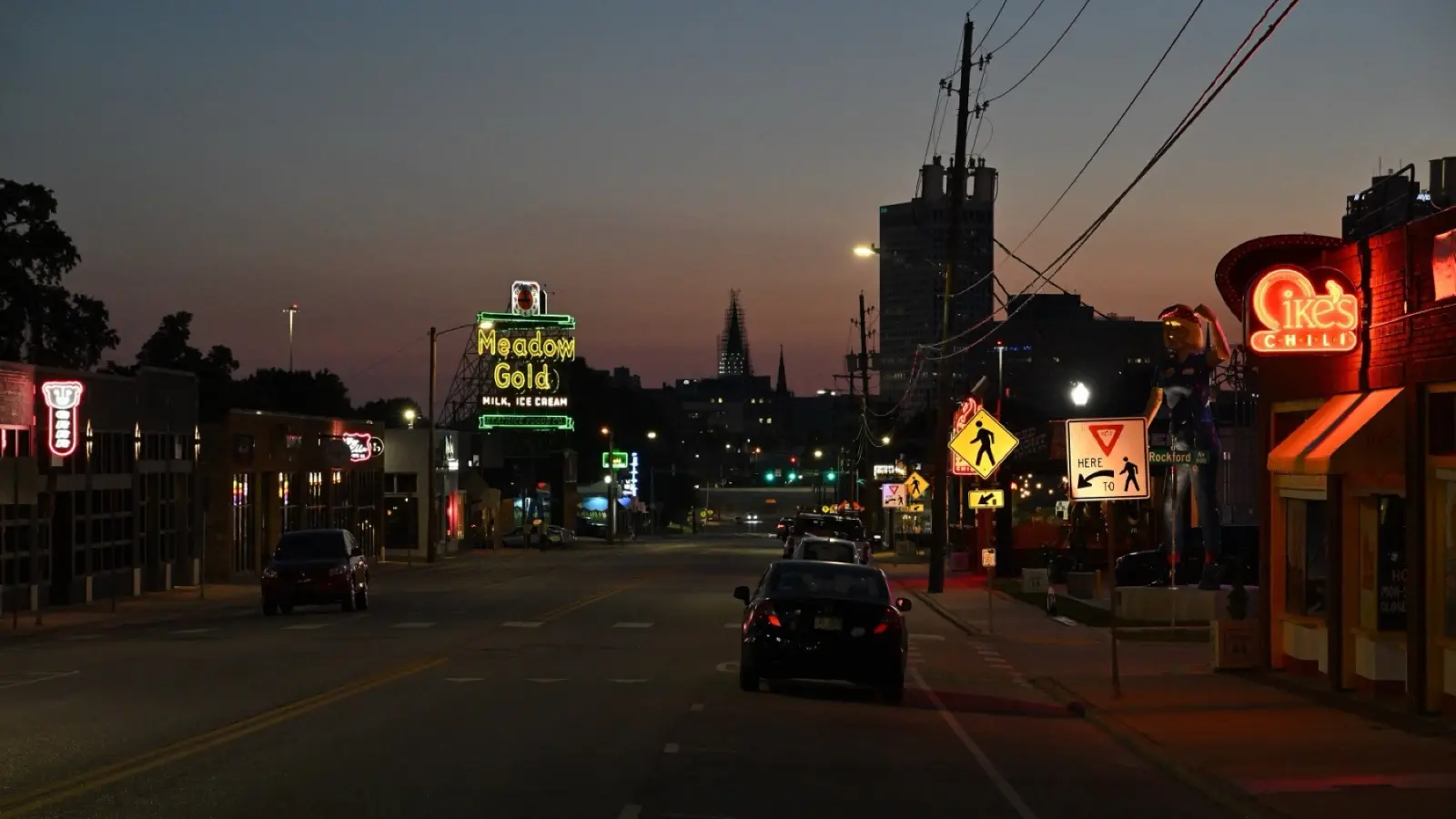
Across Quincy stands the Meadow Gold sign, a big neon milk and ice cream sign from the dairy that once advertised along the road. It was rescued and restored, and it now stands on a small pavilion at this corner, where it is lit at night. If you only come back to 11th Street once after dark, come here.
The neon signs on 11th Street
Tulsa has spent the years before the centennial putting neon back on Route 66, encouraging businesses along the road to light up again: more than 90 new neon signs have gone up at local businesses along the route. They are spread out, so the way to see them is a slow evening drive from about Yale Avenue west to the river, with a stop at Meadow Gold. On a weeknight the traffic is light enough to do it twice.
Cyrus Avery Centennial Plaza and the East Meets West sculpture
Where 11th Street reaches the Arkansas River, you come to the 11th Street Bridge, a 1916 concrete arch bridge on the National Register that carried Route 66 traffic over the river. It is closed to cars now, and the place to see it from is the Cyrus Avery Centennial Plaza at its east end, by Southwest Boulevard and Riverside Drive.
The plaza honors Avery with a bronze sculpture by Robert Summers called East Meets West. It shows the Avery family heading west in a Model T, meeting a horse-drawn wagon coming the other way, the old road meeting the new. Around it are the flags of the eight Route 66 states and a skywalk observation deck that looks out over the old bridge. Park in the lot across the road, walk up to the skywalk for the bridge view, then down the steps to see the sculpture up close; the detail on the horses is worth the stairs.
Avery is why Tulsa calls itself the Capital of Route 66. As chairman of the Oklahoma Highway Commission, he was one of the three men who wired Washington from Springfield, Missouri, on April 30, 1926, asking for the number 66. I tell that story in full in my Route 66 history.
West Tulsa: Southwest Boulevard, Red Fork and the Historical Village
Across the river, Route 66 follows Southwest Boulevard through West Tulsa. This side gets fewer visitors, and it has a different story: oil. Red Fork, the old community along the boulevard, is where Tulsa's first oil strike came in on June 25, 1901, and that well is what started the boom that made Tulsa the Oil Capital of the World.
Tulsa Route 66 Historical Village
The Route 66 Historical Village at 3770 Southwest Blvd. tells that story outdoors. Its main piece is the Frisco 4500, a restored steam locomotive known as the Meteor, and beside it stands a 194-foot oil derrick on the site of the 1901 strike. There is also the Red Fork Depot, which the village rents out for events. The village is an open-air site and free to walk around, which makes it an easy 30-minute stop on the way out of town.
Leaving Tulsa toward Sapulpa
West of the village, the historic route merges onto I-44 for a short run on the west side of the city before it splits off again toward Sapulpa. Follow the Historic Route 66 signs and you will be back on two lanes within a few miles.
Sapulpa: the 66-foot gas pump and the Rock Creek Bridge
Sapulpa, just southwest of Tulsa, is the last stop of the Tulsa stretch and the first town of the long central Oklahoma run. The reason most people stop is the Heart of Route 66 Auto Museum, a car museum whose 66-foot gas pump outside is billed as the tallest in the world. The museum is adding 5,000 square feet of exhibits and a plaza around the pump, expected to open in fall 2026, so check with the museum before you go if you want to see the new space.
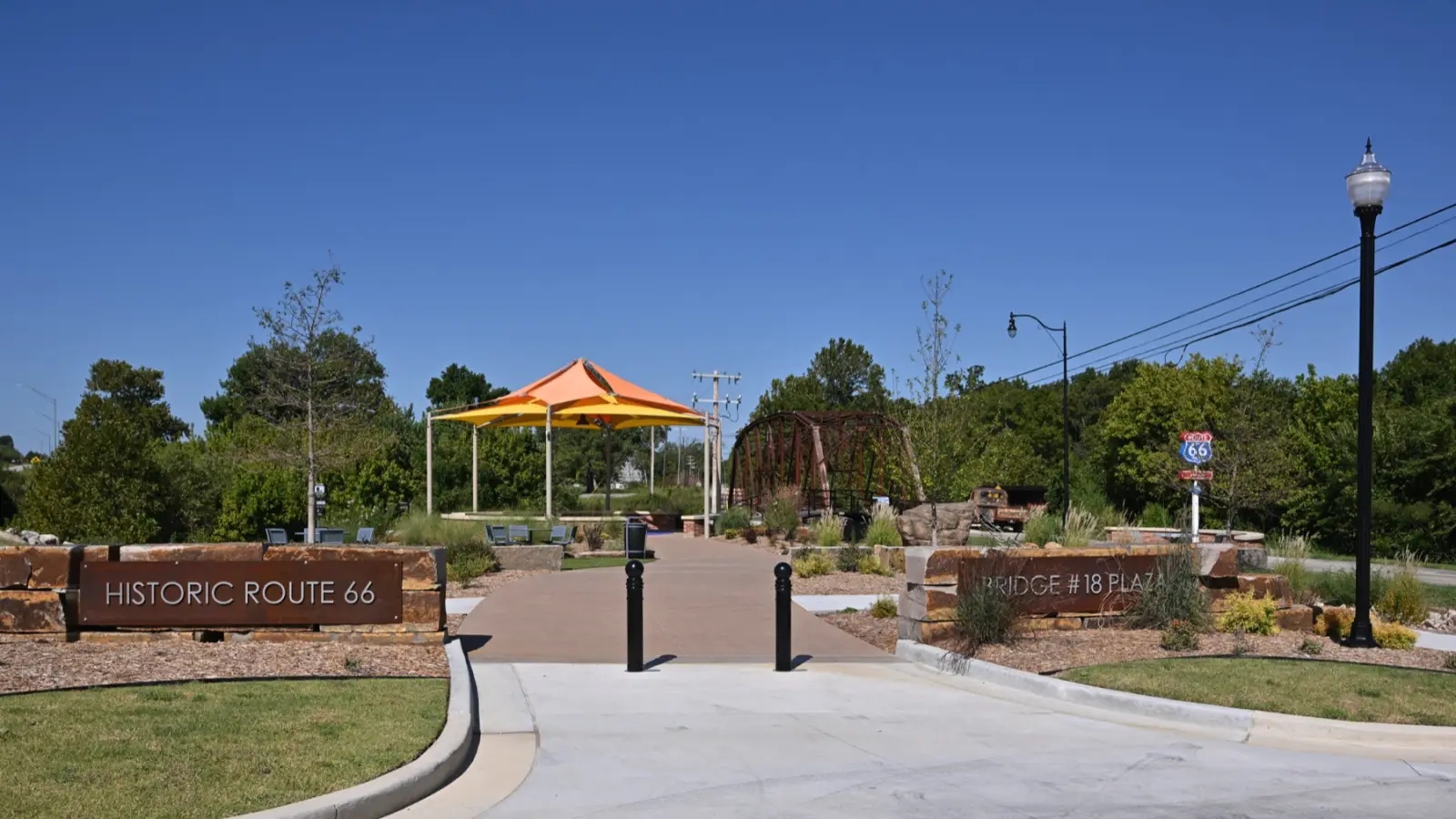
The second stop is newer. In 2026 the city built Bridge 18 Plaza, a small park with parking and a picnic area beside the old steel truss Rock Creek bridge, on West Ozark Trail. It is the photo above: a good place to stretch your legs and look at the kind of bridge Route 66 used before the highway engineers smoothed everything out.
Route 66 Tulsa to Oklahoma City: what comes next
From Sapulpa the old road heads west and southwest to Oklahoma City through Kellyville, Bristow, Depew, Stroud, Chandler and Arcadia. It is mostly two-lane road, and with stops it fills a full day; the Turner Turnpike (I-44) is the fast way between the two cities if you are short on time. The highlights I would not skip are the Rock Cafe in Stroud, built in 1939 from sandstone left over from paving the road, the Route 66 Interpretive Center in a 1937 armory in Chandler, and the Round Barn and the giant soda bottle at POPS in Arcadia. The details are in my Oklahoma stops guide, and if you want exact miles and driving hours between towns, the free Route 66 trip planner does the math for you.
Route 66 centennial in Tulsa: November 11, 2026
Route 66 turns 100 on Wednesday, November 11, 2026, and the Oklahoma Route 66 Centennial Celebration, presented by Cherokee Nation Businesses, is in downtown Tulsa and the Tulsa Arts District that day. Because it is also Veterans Day, the morning belongs to veterans and the afternoon to the road. Most of it is free. The published schedule:
- 7:00 to 8:00 a.m.: Veterans Day breakfast at VFW Post 577, 1109 E. 6th St., free and open to all.
- 11:00 a.m.: Tulsa Veterans Day Parade, downtown, free.
- 1:00 to 5:00 p.m.: a centennial crawl through eight downtown museums, galleries and history stops, free at each one.
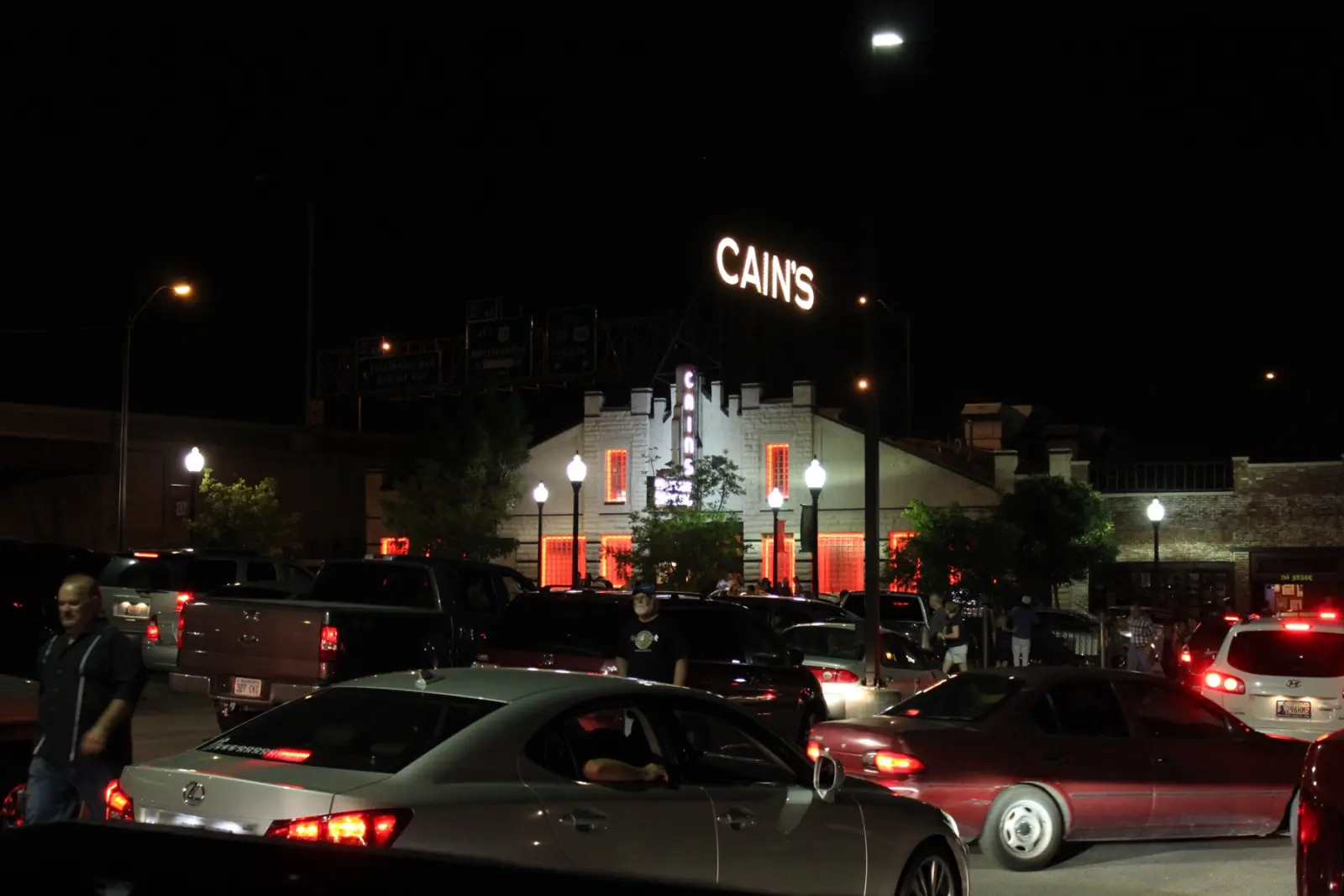
- 3:30 to 6:30 p.m.: street party on Main Street between OKPOP and Cain's Ballroom, with live music and a birthday cake.
- 5:00 p.m.: the Centennial Moment on Main Street, the official 100th birthday recognition.
- 6:00 to 7:30 p.m.: Bob Wills' Texas Playboys, free, at Guthrie Green.
- 7:00 to 9:00 p.m.: Wilderado at Cain's Ballroom, already sold out.
My advice: park once near the Arts District and walk, because every venue is within a few blocks. Then drive 11th Street after dark for the neon. Book your room now, since a parade morning plus a statewide party in one downtown fills the close-in hotels first. The rest of the birthday events in all eight states are in my Route 66 centennial events calendar.
Where to stay on Route 66 in Tulsa
I would sleep on 11th Street itself, so the neon is a short drive or a walk from your door. Two places right on the route, both with 2026 guest reviews on the big booking sites when I checked in October 2026:
- The Campbell Hotel, 2636 E. 11th St. A restored 1927 Spanish Colonial Revival hotel right on Route 66, with individually decorated rooms. The splurge, and the most Route 66 of the three.
- Desert Hills Motel, 5220 E. 11th St. The budget choice, a vintage motor inn with kitchenettes. Basic, so read recent reviews first.
If you are coming for November 11, a downtown hotel near the Arts District saves you the drive back after the concert. For the rest of the road, my picks are in the best Route 66 motels.
Where to eat on Route 66 in Tulsa
- Mother Road Market, 11th and Lewis. The food hall, with something for every person in the car. The easy lunch.
- The Blue Whale concession area, Catoosa. Not a restaurant, but the new visitor center means you can get a snack and a clean restroom at your first stop.
For diners worth the drive in the rest of Oklahoma, Stroud's Rock Cafe above all, see the best Route 66 diners.
How long to spend on Route 66 in Tulsa
Here is how I would split it, depending on your time.
| Time you have | What to do |
|---|---|
| 2 to 3 hours | Blue Whale, 11th Street with Buck Atom's and Meadow Gold, Avery Plaza |
| Half a day | Add Route 66 Rising, lunch at Mother Road Market and the Historical Village |
| Overnight | All of the above, plus 11th Street after dark and Sapulpa the next morning on your way west |
The overnight is the one I recommend. Tulsa's Route 66 is a daytime drive and a nighttime drive, and they feel like two different streets. Fall is a good season for it, as I explain in Route 66 in the fall.